Japanese Matcha Culture: A Timeless Tradition

Tradition, Craftsmanship and Ancient Tea Rituals

Japanese matcha culture began with a bit of a geographical accident. Powdered tea was invented in China, then more or less abandoned there, and it survived in Japan instead, carried home by monks who turned it into a discipline over the following centuries. The samurai class made it a mark of refinement not long after. 

Eight hundred years later, that refinement is sitting in the bowl you're about to drink from. Shade. Young leaves. Slow stone mills. None of it's new, and none of it happened because someone was tracking antioxidants.

How Matcha Came to Japan

Matcha's arrival in Japan is an interesting story.

The monks who carried it back Powdered tea reached Japan in the twelfth century, brought home by Buddhist monks who'd studied in China, where Zen monasteries used it to stay alert through long stretches of meditation. Credit usually goes to the monk Eisai, who brought back both the tea and the seeds and wrote Japan's first book on the subject, arguing tea was medicine as much as a drink. Back in China, the whole practice faded out within a few hundred years. In Japan? It took root and never let go.

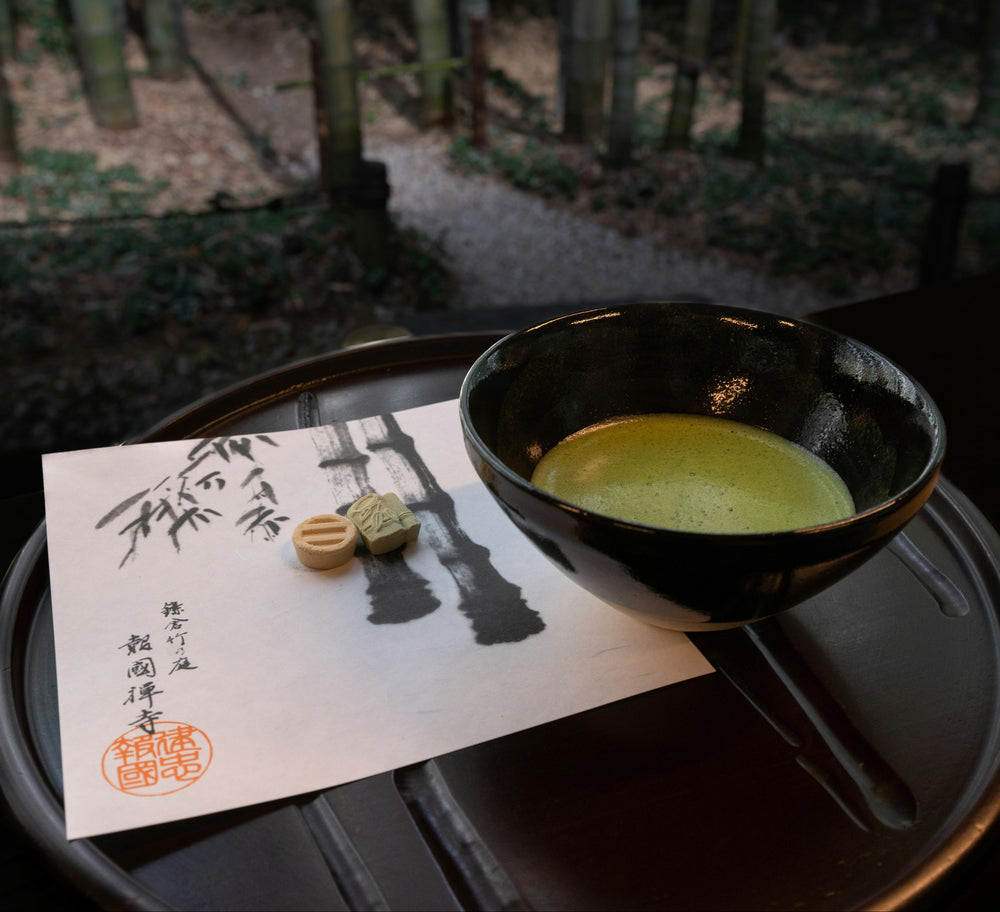
A black ceramic bowl filled with green matcha tea sits on a dark round tray next to a white paper card with black brushstroke artwork and a small green tea biscuit, with a blurred bamboo forest in the background.

From monasteries to the samurai

By the fourteenth and fifteenth centuries, matcha had left the temples behind. Tea gatherings turned into a way for the samurai elite to show off taste and judgement, and for a stretch, competitive tea tasting was genuinely the fashion. An aid to meditation had somehow become a mark of cultivation. Discipline, refinement, held together. They still are.

Chanoyu, the Way of Tea

What the tea ceremony actually is

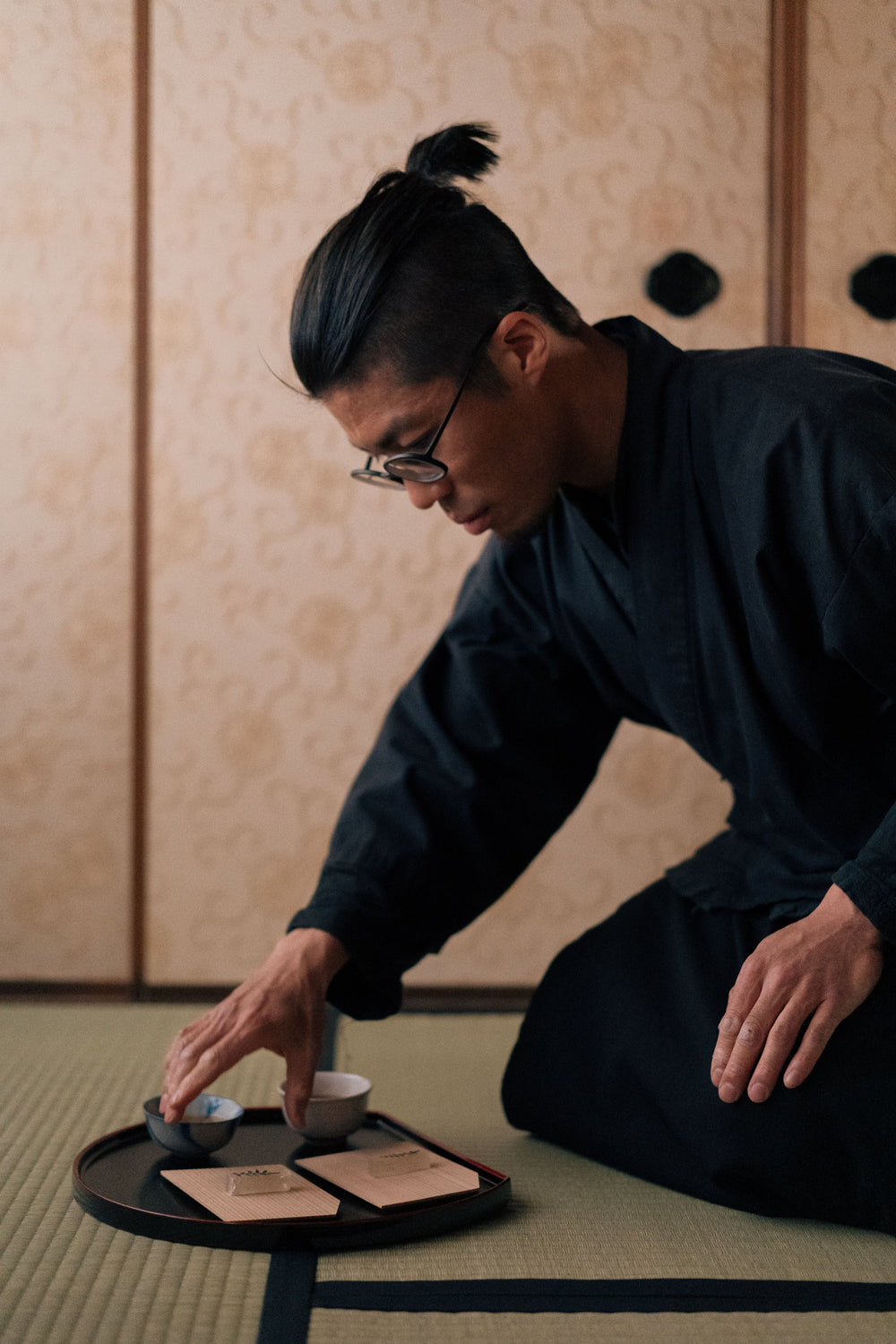
Chanoyu literally means hot water for tea, and "ceremony" undersells it a bit. Think discipline instead: a set of prescribed movements for preparing and serving a bowl of matcha, learned over years. The tea isn't really the point. The attention paid to making it is. A full formal gathering can run four hours and includes a meal, though the tea itself takes minutes.

Sen no Rikyu and the four principles

The form practised today goes back to Sen no Rikyu, sixteenth century, generally considered the most influential tea master Japan's ever had. He stripped the whole thing back on purpose. Out went the imported Chinese luxury; in came plain domestic utensils, and he shrank the tea room down so far that guests had to duck through a low door just to get in. Didn't matter who you were. Even armed samurai bowed on the way through. His four principles get boiled down to harmony, respect, purity and tranquillity, usually in that order. Rikyu himself was eventually ordered to take his own life by the very ruler he'd served. That's how seriously tea was taken back then.

Ichigo ichie, one time, one meeting

One time, one meeting. That's ichigo ichie, the phrase people always reach for when they're trying to explain chanoyu. The idea's simple enough: a gathering can't happen twice. Same people, same room, different day, and it just wouldn't be the same occasion. Reason enough, apparently, to give it everything you've got. It's why the host makes each bowl on its own rather than batching them. Why nobody's in a hurry. And it's really the only piece of the whole ceremony that's made it into everyday life untouched. Two minutes, whisking a bowl properly. That's it. That's the whole point.

Uji, the Home of Japanese Matcha

Why Uji

Uji sits between Kyoto and Nara, a small city, and it's where matcha as we know it today actually got developed. Tea's been grown there since the thirteenth century. In the sixteenth century, Uji growers worked out that shading the plants before harvest completely transformed the flavour, probably the single most important discovery in matcha's whole history. River valley mist, cool nights, four hundred years of accumulated technique behind it. That combination is why Uji still sets the benchmark, and why serious producers still put the name on the tin.

The other growing regions

Nishio in Aichi produces the largest volume of matcha in Japan, much of it destined for culinary use. Yame in Fukuoka is known for a sweeter, lower astringency tea. Kagoshima, further south, harvests earliest thanks to its warmer climate. All of them produce good matcha. None of them is interchangeable, and that's exactly why origin ends up on the label of anything made with real care.

Why single origin matters

Most matcha sold outside Japan gets blended, sometimes across regions, sometimes across countries, then sold under a brand name instead of an origin. Nothing wrong with blending on its own. But it makes traceability almost impossible to verify, and it's how tea grown well outside Japan ends up marketed as "Japanese style" anyway. A named single origin is really the only way a buyer can know what they're actually drinking.

How Tradition Shapes the Matcha

Shading the plants

Three to four weeks before harvest, the plants get covered to block most of the sunlight, a technique Uji growers worked out back in the sixteenth century. Deprived of light, the plant floods its leaves with chlorophyll and produces more L-theanine, the amino acid behind matcha's savoury depth. Colour and umami, both from one step. It's why matcha tastes nothing like unshaded green tea.

The first flush

The best matcha comes from the year's first harvest, late April into May, when only the youngest leaves are taken. Later harvests give tougher, more astringent leaves, which become culinary-grade matcha. Quality is decided in the field. Weeks before a mill ever sees it.

Steaming and de-veining

Within hours of picking, the leaves are steamed to halt oxidation, which is what keeps Japanese green tea green instead of darkening it the way black tea darkens. They're dried after that, and the stems and veins get stripped out, leaving just the soft leaf flesh behind. This de-veined leaf is called tencha. Matcha's ground from tencha, nothing else.

Stone grinding

Tencha gets milled between granite stones, turning slowly enough that friction doesn't heat and scorch the powder. A traditional stone mill manages around 30 to 40 grams an hour, roughly one small tin, and that rate hasn't shifted in centuries. It's the main reason good matcha costs what it does. Grind it at industrial speed instead, and it's quicker, cheaper, and flatter tasting. Every time.

Grades of Matcha

Organic ceremonial grade

Ceremonial Grade Matcha - Ceremonial Tea

The grades follow straight on from the practices above. Our organic ceremonial grade is first flush, young leaf, stone ground, meant to be whisked with water and drunk on its own, smooth and naturally sweet. It's the grade the tea ceremony assumes throughout. Ours is organic, JAS certified.

All-purpose ceremonial grade

Ceremonial Grade All Purpose Matcha

All-purpose ceremonial grade sits in the middle. Clean enough to whisk and drink. Robust enough to hold its flavour through milk, which makes it the sensible pick if you're having matcha daily with milk. This one is non-organic.

Café grade organic

Get Matcha for Cafe online - Tea & Infusions

Café grade organic is built for the milk jug. It's bolder and more assertive than all-purpose, so it doesn't go quiet under steamed milk, oat milk or a shot of syrup. Not really a bowl matcha, and it doesn't pretend to be. If you're making lattes all day, or running a café that is, this is the one. Ours is organic, JAS certified.

Culinary grade

Culinary Grade Matcha Green Tea Powder - Tea & Infusions

Culinary grade comes from later harvests, older leaves. Sharper. More astringent. Sounds like a knock against it and really isn't, because in a cake or an ice cream it's up against sugar, butter and flour, and a delicate ceremonial matcha would just disappear in that fight. Bitterness in a bowl is a fault. Bitterness in a brownie is the point. Ours is organic, JAS certified.

Organic or not?

Organic here means JAS certified, the Japanese Agricultural Standard. The leaves come from farms that are inspected and certified, with no synthetic pesticides or chemical fertilisers. Non-organic matcha is still Japanese, still one ingredient, just grown without that certification. Organic tells you how it was farmed. Grade tells you how it tastes and what it's for. They're separate things, which is why you'll find some grades in both.

Matcha in Japan Today

Matcha in Japan Today

The formal tea ceremony's a minority pursuit these days, taken seriously by a relatively small number of people who mostly study it for years under a teacher. Matcha itself is everywhere though. Whisked at home, poured over ice in convenience stores, folded into confectionery, served in Kyoto and Tokyo cafes the same way coffee gets served everywhere else.

Both things are true at once. The everyday version isn't some lesser copy of the ceremonial one; the care's just spread out differently. A bowl whisked properly at the kitchen bench has more in common with the tea ceremony, honestly, than a rushed formal gathering has with an instant sachet. What the tradition actually asks for is attention. Not ritual.

What Matcha Tastes Like

What Matcha Tastes Like

Good matcha's savoury before it's sweet. Umami hits first, that same broth-y depth you'd get off seaweed, or a decent hard parmesan if you're after a stretch. Then the grassiness turns up, vegetal, a bit green. And underneath the whole thing, sweetness, just sitting there, lingering. All of it traces back to the shading; no other way round it. Honestly? That's the entire reason the practice stuck.

Bitter. Chalky. Fishy. None of those belongs anywhere near a good bowl. Bitterness, nine times out of ten, means the water ran too hot, or somebody reached for the wrong grade. Chalky's easier still: powder that never got sifted. And fishy, that hay-like note creeping in? Old matcha. Oxidised. Doesn't take long either; a few months after opening the tin and it's already turning. Once it's gone that way, there's no bringing it back. None.

Questions. Answers.

Ceremonial-grade matcha sourced directly from Japan's finest tea gardens. One ingredient. No fillers.

Not Japan, originally. China had powdered tea centuries before it ever reached Japanese shores, carried over by Buddhist monks in the twelfth century. It died out in China not long after. Japan kept it alive, built a whole ceremony around it, and turned it into something the rest of the world now associates purely with them.

People call it chanoyu. Sen no Rikyu formalised it in the sixteenth century around four principles: harmony, respect, purity, and tranquillity; honestly, the tea is almost beside the point. It's a discipline in paying attention to something most people rush through without thinking.

Uji growers figured out the shading technique that defines matcha's flavour, full stop. They've had tea growing there since the thirteenth century, so you're looking at climate and centuries of trial and error stacked on top of each other. That's the entire reason the region still carries the reputation.

Not even close. Most matcha in Japan is made at a kitchen counter in a couple of minutes, no ritual involved, and a properly whisked bowl at home arguably gets closer to the tradition's actual point than a formal ceremony does. Attention was always the ask, never the theatre around it.

One time, one meeting. This gathering, right now, won't happen again in exactly this way, and that's the whole justification for giving it your full focus. Of all the phrases tied to the tea ceremony, this one gets quoted the most, and it earns that.

Shading the plants cuts down how much you can harvest. Add in that only the youngest leaves make the cut, that someone has to strip stems and veins out by hand, and that a stone mill still only produces 30 to 40 grams an hour, and the price stops looking unreasonable. It's time and loss built into the process, not a markup.